

“UK Biobank is up there with [Wellcome’s] greatest achievements from the last 25 years…and perhaps more than any other, UK Biobank will continue to be talked about in 100 years.”
Sir Jeremy Farrar, Director of Wellcome, 2013-2023
UK Biobank was established in the early 2000s to enable researchers around the world to make discoveries that improve human health.
Our vision was supported by our founders:
- Wellcome
- Medical Research Council (MRC)
- Department of Health and Social Care
- The Scottish Government
- Northwest Regional Development Agency.
Professor Sir Rory Collins was appointed as the Principal Investigator and Chief Executive of UK Biobank in 2005.
Participant recruitment timeline
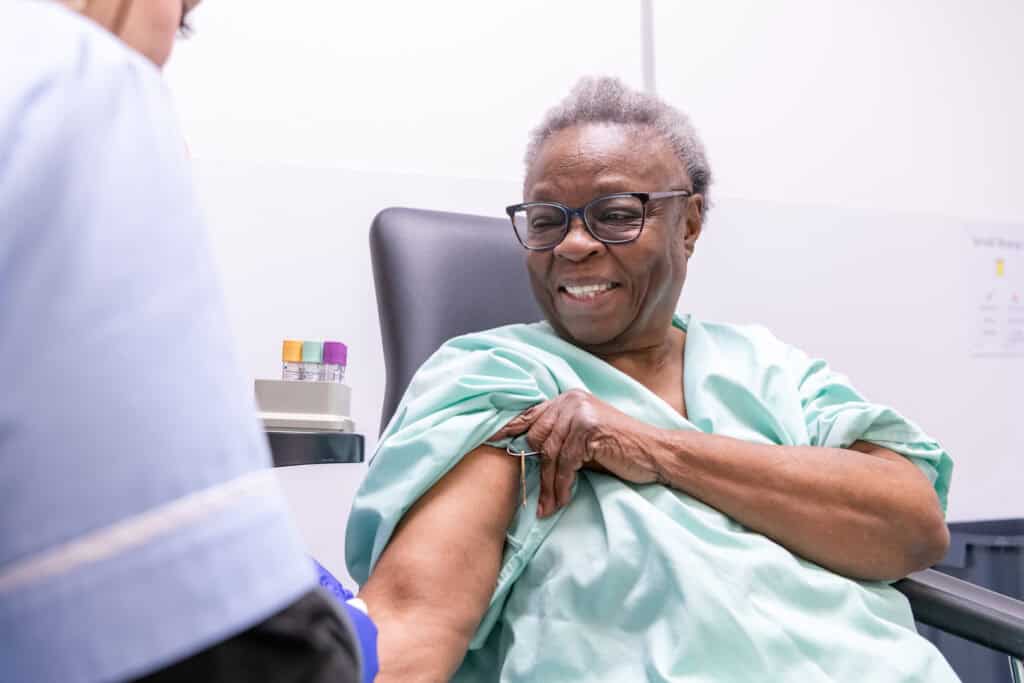
Half a million participants have been generously providing a vast amount of information about their health over the years.
We continue to collect data from existing participants, but we are not currently recruiting new participants.
-
 2005-2006
Pilot stage of recruitment
3,800 people completed the pilot stage of recruitment at a fully integrated clinic in Altrincham, Greater Manchester.
-
 April 2007
Main phase of recruitment begins
Up to 35 regional centres from across the UK opened for the main phase of recruitment.
50,000 people had taken part by the end of 2007. -
 August 2010
Baseline recruitment completed
By August 2010, all 500,000 participants were recruited.
We will continue to track their health at least 30 years thereafter.


Major projects timeline

Since UK Biobank began, our database has been enhanced by multiple amazing scientific projects.
These projects are helping researchers to accelerate public health discoveries around the globe.
-
 August 2014
Imaging study launches
The £43 million study to scan 100,000 participants is funded by the MRC, Wellcome and the British Heart Foundation.
-
 January 2018
Exome sequencing project begins
An industry collaboration between Regeneron, AbbVie, Alnylam Pharmaceuticals, AstraZeneca, Biogen, Takeda, Bristol Myers Squibbs and Pfizer provides funding for a pioneering study into exome sequencing.
-
 April 2018
Whole genome sequencing vanguard study begins
A £30 million initiative funded by the MRC begins to complete whole genome sequencing on 50,000 participants.
-
July 2019
Repeat imaging begins
Dementias Platform UK funds repeat imaging of 10,000 participants.
-
September 2019
Whole genome sequencing on the full cohort begins
A £200 million investment from government, industry and charity enables whole genome sequencing on the remaining 450,000 participants.
-
 May 2020
COVID-19 seroprevalence study begins
A six month study of COVID-19 in 20,000 participants and their relatives begins, funded by the Department of Health and Social Care.
-
 September 2021
Research Analysis Platform launches
The Research Analysis Platform (UKB-RAP), an innovative cloud-based platform, launches to increase scale and accessibility of the resource.
-
September 2022
Repeat imaging project announced
The £30m initiative to re-scan 60,000 participants is funded by the Medical Research Council, Calico Life Sciences and the Chan Zuckerberg Initiative.
-
April 2024
New fund launches for researchers in developing countries
UK Biobank launches a new Global Researcher Access Fund that covers application costs of approved researchers at institutes from less wealthy countries, aiming to further democratise worldwide access.
-
January 2025
Protein study on the whole cohort begins
UK Biobank announces the launch of the world’s most comprehensive study of the proteins circulating in our bodies, aiming to measure up to 5,400 proteins in each of 600,000 samples, funded by a consortium of 14 leading biopharmaceutical companies known as the UK Biobank Pharma Proteomics Project.


Major data releases timeline

Our unique biomedical database is the largest, most detailed and most widely accessible of its kind.
The database is constantly growing and we aim to make new data available to researchers once or twice a year.
.
