
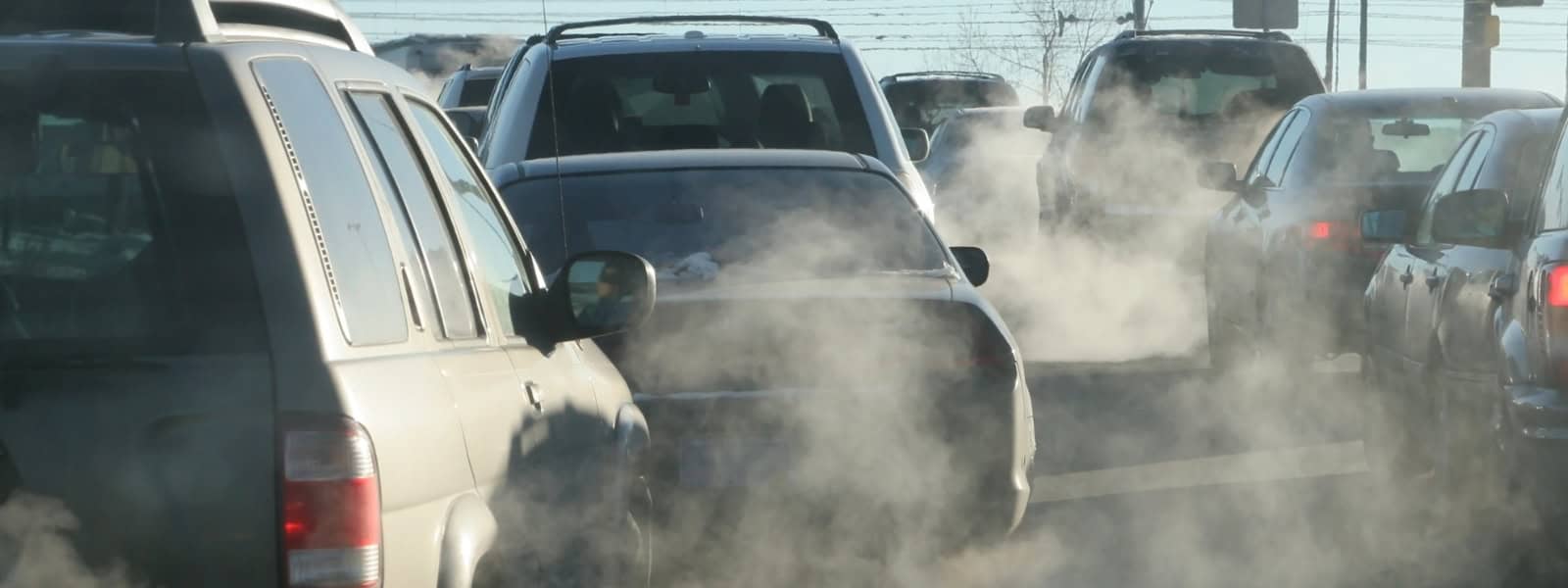
Tiny airborne particles cause inflammation in the lungs, which can turn harmless mutated cells into cancerous tumours.
Summary
Certain air pollutants seem to promote lung cancer by causing inflammation, which turns otherwise harmless mutated cells into tumours. The study, which used data from more than 400,000 UK Biobank participants, has been picked up by policymakers and green-energy companies because it suggests that reducing air pollution levels will benefit our health.
Certain air pollutants seem to promote lung cancer not by damaging DNA but by driving inflammation, which ‘wakes up’ cancer-causing mutations that accumulate naturally as we age.
The study was hailed as a tour de force, combining research on cells and mice with human health data, including information from more than 400,000 UK Biobank participants. It piqued the interest of policymakers and green-energy companies advocating for pollution-lowering measures.
Smoking is the biggest cause of lung cancer. But around 15% of people diagnosed with lung cancer in the UK have never smoked. This ‘lung cancer in never-smokers’ has unique characteristics and responds differently to treatment than cancer caused by smoking. Understanding what causes this type of cancer should help to detect it earlier, refine treatment plans and maybe even prevent it.
Around 6,000 people who never smoked die of lung cancer every year. That’s more deaths than from leukaemia or ovarian cancer. Diagnoses are often made only when the cancer is already at an advanced stage, because non-smokers and their doctors tend to dismiss early symptoms as benign – they often don’t expect anything serious.
Reasons for why non-smokers develop lung cancer are numerous: genetics, having other lung conditions such as asthma and environment, including air pollution, can all play a role.
The most dangerous pollutant
[This study] means that we can start thinking about ways to detect these changes, and also think about ways to intervene and possibly prevent these changes, to prevent cancer formation.
William Hill, Francis Crick Institute, UK
Out of all the air pollutants, PM2.5 is one of the most harmful. It consists of particles less than 2.5 micrometres in diameter, 100 times smaller than the diameter of a human hair. These can travel deep into the lungs and have been linked to many health conditions.
Researchers long thought that PM2.5 causes cancer in the same way cigarette smoke does: it directly damages DNA, leading to mutations that can develop into cancerous tumours.
A large team of scientists have now found that PM2.5 pollutants kick start an inflammatory process that activates already mutated cells. Mutated lung cells accumulate naturally as we age. They don’t tend to cause any problems – until inflammation converts them into cancerous tumours.
Study co-leader William Hill from the Francis Crick Institute, UK, is excited by the discovery: “It means that we can start thinking about ways to detect these changes, and also think about ways to intervene and possibly prevent these changes, to prevent cancer formation.” Many inflammation-reducing drugs already exist, Hill points out, and they could be a starting point for developing ones that stop cancer-causing inflammation.
Anna Hansell, a specialist on the health effects of air pollution from the University of Leicester, UK, says that the study nicely combined big data with lab experiments: “It was quite a coherent story – you don’t always see that.”
She hopes studies like this encourage other environmental health researchers to use large databases such as UK Biobank. “It’s not a big proportion of lung cancers in non-smokers, but when you’ve got a large enough dataset, you are able to examine that.”
A push for policy change
Hill says that the work intrigued policymakers and green-energy companies because it lends support to the idea that reducing air pollution levels will benefit our health.
In 2040, new air quality limits will halve the allowed average levels of PM2.5 in England over a year – from the current 20 micrograms per cubic metre to 10. The European Union is aiming for the same limit but will introduce it 10 years earlier. The World Health Organization currently recommends an upper annual limit of 5 micrograms per cubic metre.
“The air pollution levels we’ve got now are a lot lower than they used to be, say, in the 1950s and earlier, when you could see it and smell it,” Hansell says. “Now you can be exposed to levels that aren’t healthy, but you wouldn’t necessarily know, and that’s quite something to get your head around.” Some places around the UK are already staying well below the 2040 limit today, whereas others, for example large cities, have more work to do.
Hansell hopes for more research into ways to – at least partially – mitigate negative health effects of air pollution. “We don’t know if other aspects of lifestyle might offset some of those impacts.” Of course, she adds, reducing air pollution remains the ultimate goal.